

USGS Report Finds Appalachian Lithium Cache That Could Cut Import Reliance
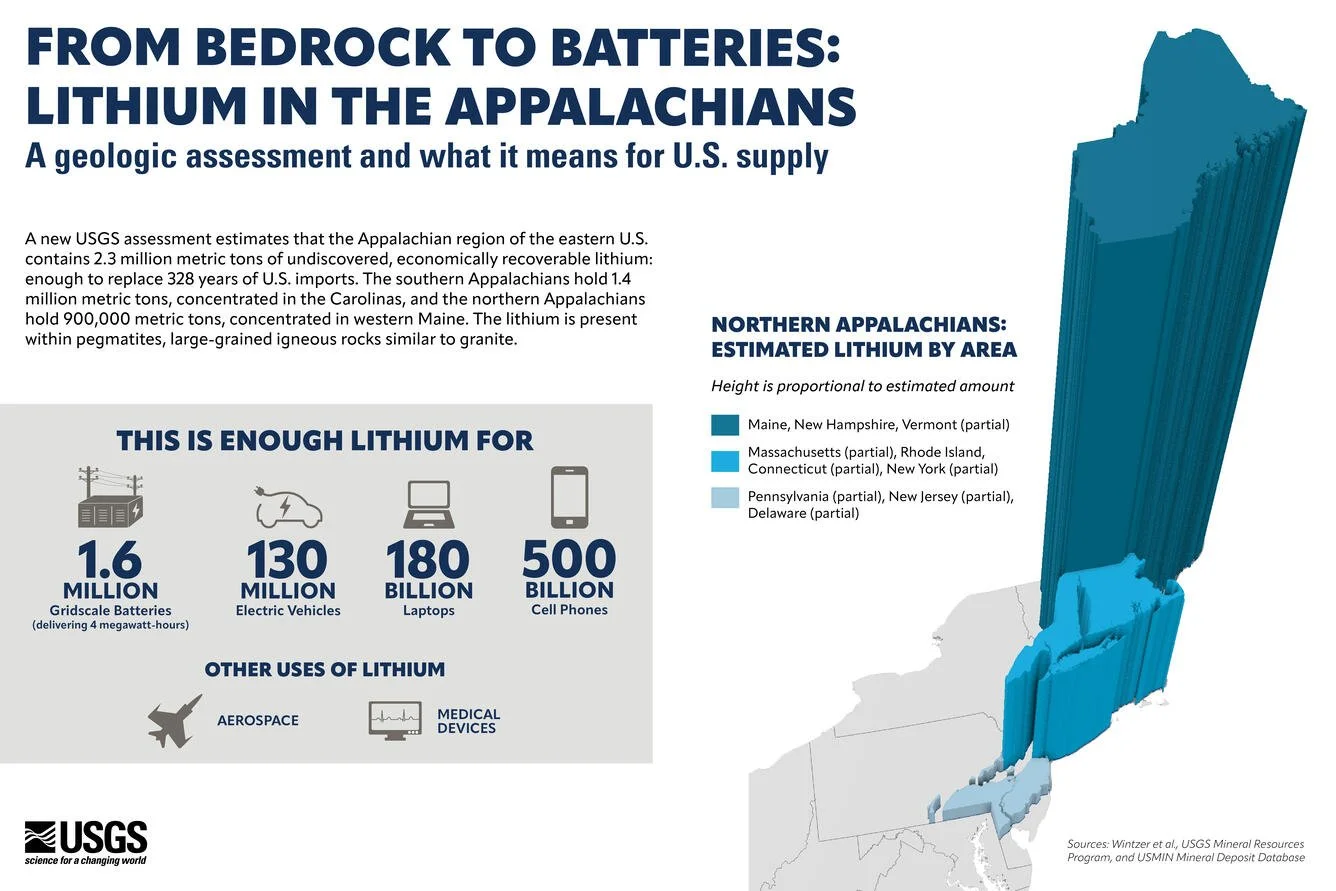
Map showing concentration of lithium in pegmatites in the northern Appalachians, and showing use cases for 2.3 million metric tons of lithium oxide, the amount USGS scientists estimate is economically recoverable from the Appalachian region.
A new U.S. Geological Survey report says lithium-bearing pegmatites in the Appalachian region could become a major piece of America’s domestic critical minerals strategy, potentially enough to offset current U.S. lithium import needs for more than a century.
The USGS estimates the Appalachian region holds about 2.3 million metric tons of economically recoverable lithium oxide, including 1.43 million metric tons in the southern Appalachians and 900,000 metric tons in the northern Appalachians.
That’s enough lithium oxide for an estimated 130 million electric vehicles, 1.6 million grid-scale batteries, 180 billion laptops or 500 billion cellphones, according to USGS.
What They Found
The northern Appalachian assessment, published in Natural Resources Research, focused on lithium-mineralized pegmatites across the Northeast, with the strongest potential concentrated in Maine, New Hampshire and part of Vermont.
The report estimates 900,000 metric tons of lithium oxide may be economically extractable there.
The report emphasizes uncertainty, noting that more exploration, higher-resolution geophysical surveys and better geochemical data would help refine the estimates.
The Arkansas Angle
USGS also notes its 2024 assessment of the Smackover Formation, which estimated 5 million to 19 million metric tons of lithium in brines in southwest Arkansas, though it did not estimate how much could be economically recovered.
The Bottom Line
The findings strengthen the case that the U.S. has significant domestic lithium resources, but turning geology into supply will depend on investment, permitting, processing capacity and commercial-scale extraction.
More: Access the full USGS Appalachian region report and the report summary.
Previously: USGS Report Shows Arkansas Sitting on Vast Lithium Reserves (Oct. 25, 2024)
